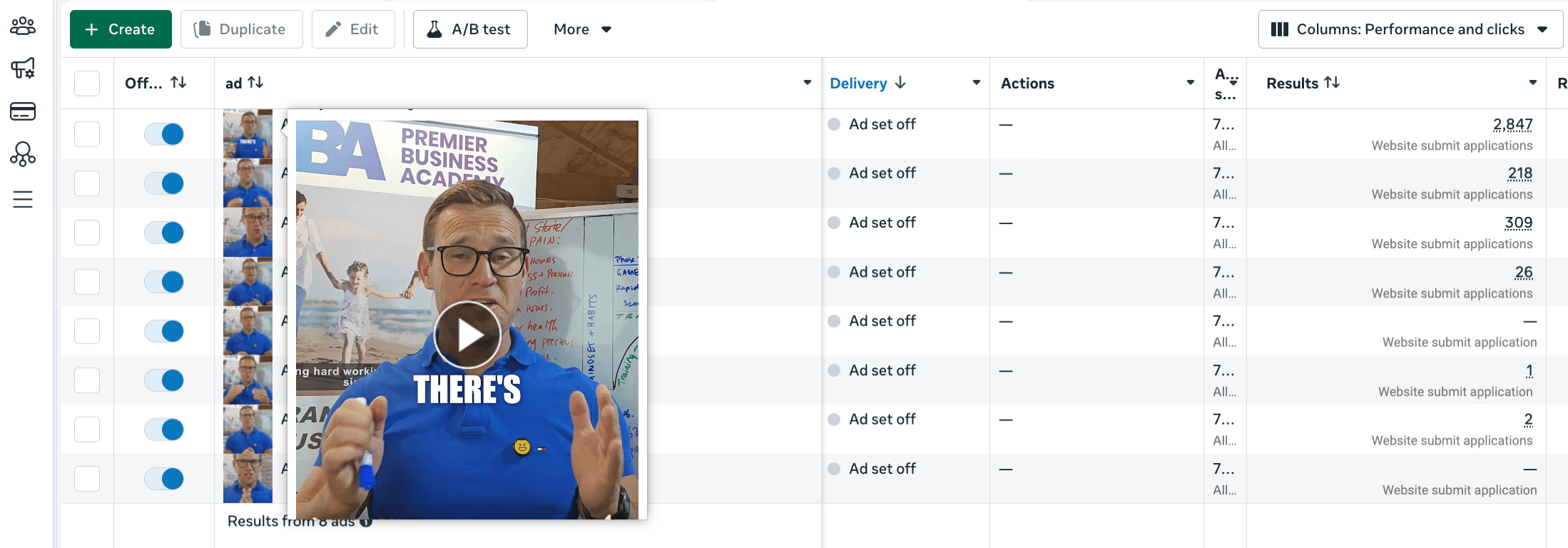
Answer first: the retained evidence supports 3,403 website submit applications across eight Meta ads and a separate snapshot of 149 total Skool members. It does not support 149 paid acquisitions, a 4.4% lead-to-paid conversion rate, or revenue derived by multiplying community size by list price.
What the records actually show
Both screenshots are useful. They answer different questions. The Meta view shows creative-level application results; the Skool view shows a point-in-time community listing. A defensible acquisition claim needs the missing contact-level link between them.

The evidence boundary
Supported
- The Meta screenshot contains eight ads and 3,403 website submit applications in total.
- One ad accounts for 2,847 of those applications—about 84% of the displayed total.
- The separate Skool snapshot shows a private community with 149 total members.
- The same Skool snapshot shows a listed price of $499/month and 50 course items.
Not established
- That all 149 members were paid acquisitions.
- That any specific Meta application became a Skool member.
- A 4.4% lead-to-paid conversion rate or any derived revenue figure.
- Ad spend, cost per lead, webinar attendance, retention, or return on ad spend.
What can be learned without overclaiming
The creative distribution is the strongest usable finding. One ad generated roughly 84% of the displayed application results. That supports a narrow lesson: creative performance was highly concentrated, so testing multiple executions mattered.
It does not prove why that ad won. The retained screenshot does not expose audience, spend, impressions, cost per application, delivery period, or downstream customer quality. Any explanation of the mechanism would be a hypothesis until those fields are recovered.
The missing proof is specific: export the 3,403 application records with campaign identifiers, join them to Skool or payment records at contact level, and then report paid conversions, refunds, retention, and revenue by source. Until that join exists, those outcome states stay separate.
Evidence method
A result is not an outcome until the records join.
We now track ad result, contact, booked call, qualified meeting, payment, retention, and revenue as separate states. That makes the public proof smaller—but much more useful to an operator deciding what the evidence really says.